The Leadership Bottleneck
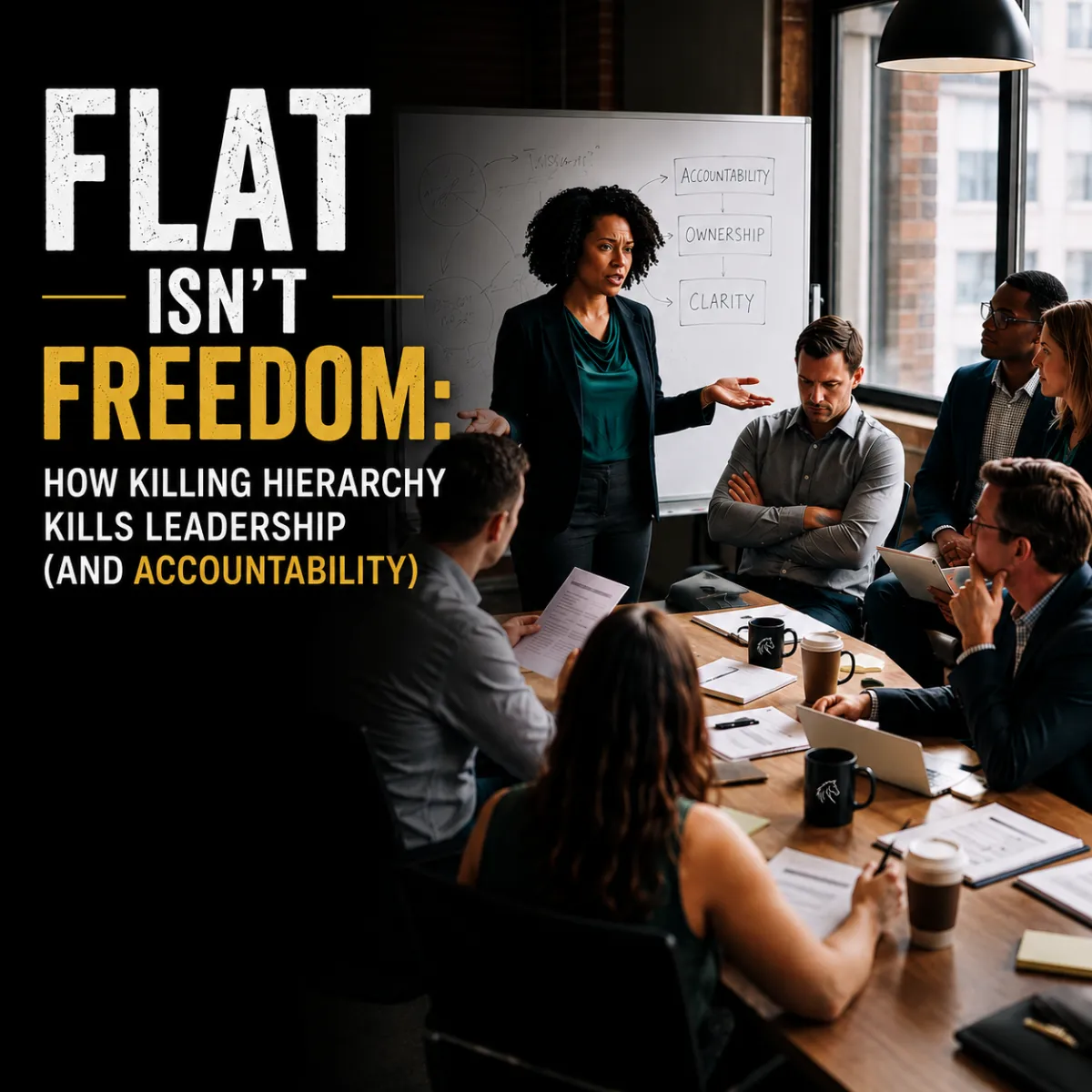
The Leadership Bottleneck: Why "Flat" Organizations Kill Accountability (And How to Cross the Divide)
I’ll say it plainly: if your organization calls itself “flat,” but decisions still stall, your best people are exhausted, and every meaningful call still runs through you, you do not have a modern structure. You have a leadership bottleneck.
I’ve seen this pattern for years. In GovCon. In growth-stage companies. In founder-led firms that say they want agility but actually avoid accountability. They sell the idea of “no titles,” “shared ownership,” and “pure collaboration” because it sounds progressive.
Most of the time, it is not progress.
It is leadership failure.
That is the core issue I address through Blue Stallion Leadership, my leadership development work, and my executive leadership coaching. A flat structure is not freedom. It is usually a vacuum. And when leadership leaves a vacuum, politics, confusion, delay, and resentment rush in fast.
If you want to scale, you need to cross the divide from informal control to intentional leadership. That is what I teach in Crossing the Divide, and it is the work behind Blue Stallion Leadership.
Flat Is Not Lean. Flat Is Usually Weak Leadership.
A lot of leaders hide behind the word “flat” because they do not want to do the hard parts of leadership. They do not want to clarify roles. They do not want to make the final call. They do not want to coach under performers. They do not want to deal with the discomfort that comes with authority.
So they remove structure and call it culture.
I call it what it is: avoidance.
In a so-called flat organization, the same problems show up every time. Projects drift. Meetings multiply. Decisions slow down. Everyone gets a vote, but nobody owns the result. The strongest personality wins. The clearest process loses. Accountability disappears.
That is not empowerment. That is a leadership bottleneck disguised as innovation.
And if you are the founder, president, or senior executive, you are usually the source of it.
The Real Problem: You Refused the Leadership Transition
When the leadership is failing, most of the time is not because a lack of effort. They fail because they never make the leadership transition.
They built the company as a high-performing doer. They won business. Solved problems. Closed deals. Put out fires. That worked early. Then the company grew, but their operating style did not.
This is where I see the biggest new leader challenges show up, especially in growing firms. The business needs structure, delegated authority, and managers who can lead. But the top leader still behaves like the chief fixer. Still inserts themselves into every issue. Still wants consensus on everything. Still thinks accessibility is the same as leadership.
It is not.
At some point, every serious executive has to make the identity shift leadership demands. You stop being the hero in the middle of every problem. You become the architect of the system. You move from doing to deciding. From solving to scaling. From personal output to leading leaders.
If you never make that shift, your company stays stuck around you.

Flat Structures Create Confusion, Not Accountability
I have never seen a truly flat company at scale that did not suffer from decision drag, hidden power centers, or burnout. There is a reason.
Authority does not disappear just because you refuse to define it.
When you strip away formal structure, you do not eliminate hierarchy. You create an unofficial one. That shadow hierarchy is based on access, personality, tenure, politics, and proximity to the founder. It is harder to see and harder to challenge.
That is why flat organizations usually destroy accountability.
People do not know who owns what. Teams do not know where decisions sit. Managers lack authority but still carry responsibility. High performers get frustrated because weak performers are protected by ambiguity. This is where team dynamics leadership breaks down fast.
And once that starts, culture gets worse by the quarter.
People stop speaking clearly. They hedge. They wait. They escalate sideways. They seek permission from the room instead of direction from a leader. Execution slows because nobody wants to overstep, and nobody has been given clean authority.
You can call that collaboration if you want.
I call it organizational drift.
The Math Breaks Down Fast
There is also a practical limit here. A leader cannot effectively coach, direct, and hold accountable 25 or 30 direct reports just because the company wants to feel “non-hierarchical.”
That is fantasy.
If you have 8 direct reports, you can develop them. You can evaluate performance. You can create real follow-through. If you have 30, you are not leading. You are reacting.
That is how the leadership bottleneck gets worse. The company grows in headcount but not in leadership capacity. Work expands. Clarity shrinks. The top leader becomes the default approval point for everything meaningful.
Then they wonder why the team moves slowly.
The answer is simple: your structure is flat because your leadership is underbuilt.
Cross the Divide or Stay the Bottleneck
This is exactly why I talk about the need to cross the divide.
That divide is not theoretical. It is operational. It is the line between being the center of activity and becoming the leader who builds leaders. It is the line between control and scale. Between founder instinct and organizational discipline.
That is the central idea behind Crossing the Divide Rob Marcus and the broader leadership development work I do.
If you are serious about growth, you have to accept the reality of the leadership transition. You cannot keep one foot in the doer role and one foot in the executive role forever. That split posture creates confusion for everyone around you.
The move requires an identity shift leadership does not let you avoid.
You need to stop asking:
How do I stay involved in everything?
How do I keep everyone equal?
How do I avoid upsetting people?
And start asking:
Who owns this outcome?
Who has decision rights?
Who is coaching this person?
Where is accountability visible?
How do I scale judgment across the organization?
That is strategic thinking for leaders. Not more effort. Better structure.

My Doer to Leader Framework
This is where my doer to leader framework comes in.
I built this work for executives who are strong operators but stuck in the wrong role inside their own company. They are carrying too much. Their managers are underdeveloped. Their decisions pile up. Their team waits too long for clarity. The business says it wants scale, but the leader is still functioning like a super employee.
That does not scale.
My doer to leader framework focuses on three moves:
Role Clarity
Every leader needs a defined output. Not vague participation. Not committee ownership. Real accountability.Visible Authority
Decision rights must be documented and understood. If people have to guess who can decide, your structure is already failing.Leading Leaders
The goal is not to manage more tasks. The goal is to build people who can carry authority, coach performance, and create consistency without you in the middle.
This is one of the biggest problems in scaling leadership in growing companies. The business adds revenue, contracts, and headcount, but it never upgrades the leadership model. So the executive team gets buried in tactical noise and calls it growth.
It is not growth if the whole machine still depends on one or two people.
Strategic Thinking for Leaders Means Building Structure That Holds
Real scale requires more than hiring. It requires operating discipline.
That means clear lines of management. Clear decision authority. Clear coaching responsibility. Clear standards. This is what serious leadership development looks like in practice. Not slogans. Not inspiration. Structure.
This is also why I push hard on strategic thinking for leaders. Strategic leadership is not abstract. It is the ability to design an organization that performs without constant executive rescue.
If you are stuck in constant intervention, your issue is not workload. Your issue is leadership design.
And if you are trying to fix that with a flatter org chart, you are making it worse.
Better structure beats fake freedom every time.
Leading Leaders Is the Real Job
A lot of executives think leadership means staying available to everyone. It does not. Leadership means building the next layer of capable leaders so your company does not collapse into you.
That is the real work of leading leaders.
It requires trust, standards, coaching, and consequence. It requires letting managers actually manage. It requires helping them think, decide, and own results. It requires you to stop rescuing every situation just because you can.
This is where team dynamics leadership gets stronger. Not when everyone is equal. When everyone is clear.
When leaders know their lane, teams move faster. Conflict gets resolved earlier. Escalation gets cleaner. Performance improves because accountability is visible. That is how you reduce friction and increase execution at the same time.
Ready to Cross the Divide?
If you are serious about scaling leadership in growing companies, stop pretending flat is healthy. Stop calling ambiguity empowerment. Stop letting a weak structure choke performance.
It is time to cross the divide.
Through Blue Stallion Leadership, I help executives make the leadership transition, solve the leadership bottleneck, strengthen team dynamics leadership, and install the operating discipline required for real scale. This is the work behind Crossing the Divide and the reason companies bring me in when growth has started to outrun leadership.
Limited availability. I only work with a select number of firms that are ready to do the work.
Schedule your free 30-minute leadership assessment with Rob Marcus today.
If you are ready for real leadership development, ready to make the identity shift leadership requires, and ready to apply a proven doer to leader framework, let’s talk.
Blue Stallion Leadership. Built for leaders who are done being the bottleneck.